Research

Probabilistic tsunami hazard assessment

From uncertain earthquake sources to non-stationary tsunami hazard under tides and climate-driven sea-level rise.

Featured research · PTHA / nPTHA

A research program on uncertainty, changing sea level, and tsunami risk

Our probabilistic tsunami hazard work developed from representing uncertain earthquake slip and source location, to regional PTHA in the South China Sea, and then to non-stationary PTHA (nPTHA) that compounds tsunami occurrence with tides and climate-driven sea-level rise.

2017

Foundations

Uncertain earthquake slip distribution and source location

Introduced probabilistic tsunami hazard calculations that propagate uncertainty in earthquake slip and source location into coastal tsunami response.

Sepúlveda, Liu, Grigoriu & Pritchard (2017), Journal of Geophysical Research: Solid Earth.
2019

South China Sea

Regional PTHA with uncertain earthquake characteristics

Applied the probabilistic framework to the Manila Subduction Zone and quantified tsunami hazard for South China Sea coastal sites, including the sensitivity of long-return-period hazard to earthquake recurrence assumptions.

Sepúlveda, Liu & Grigoriu (2019), JGR: Solid Earth, 124(1), 658–688.

Article
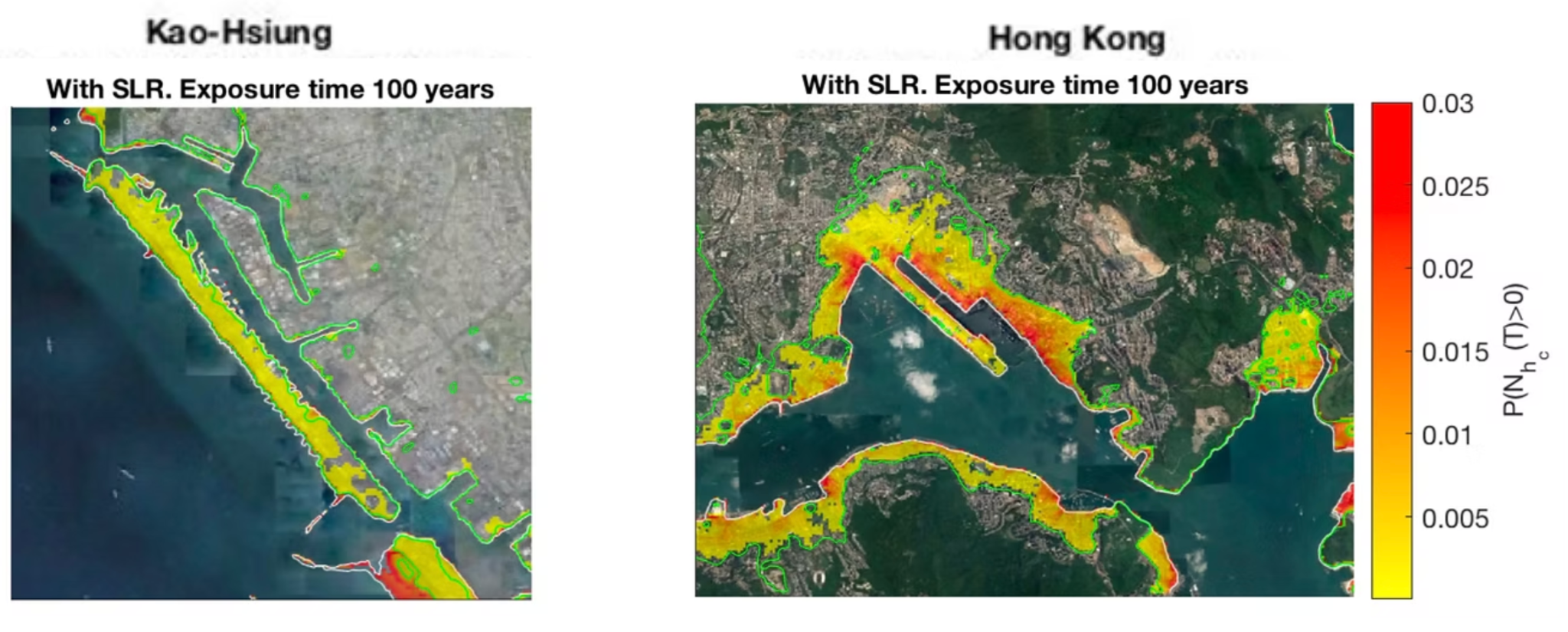
Probabilistic tsunami hazard results for Kaohsiung and Hong Kong in the South China Sea
South China Sea PTHA results for Kaohsiung and Hong Kong with sea-level rise and a 100-year exposure time.
2021

Non-stationary PTHA

Climate-change-driven sea-level rise

Extended PTHA to a non-stationary framework in which future tsunami inundation probability evolves as mean sea level changes through time.

Sepúlveda, Haase, Liu, Grigoriu & Winckler (2021), Earth's Future, 9(6), e2021EF002007.

Article
2022

Tides + sea-level rise

nPTHA compounding tides and sea-level rise

Expanded the non-stationary formulation by explicitly compounding tsunami occurrence with tidal stage and climate-driven sea-level rise.

Sepúlveda, Liu, Grigoriu, Haase & Winckler (2022), Earth's Future, 10(11), e2022EF002965.

Article
2025

Southern California · with Andrew Mosqueda

Sea-level rise increases Alaskan and Cascadian tsunami hazard

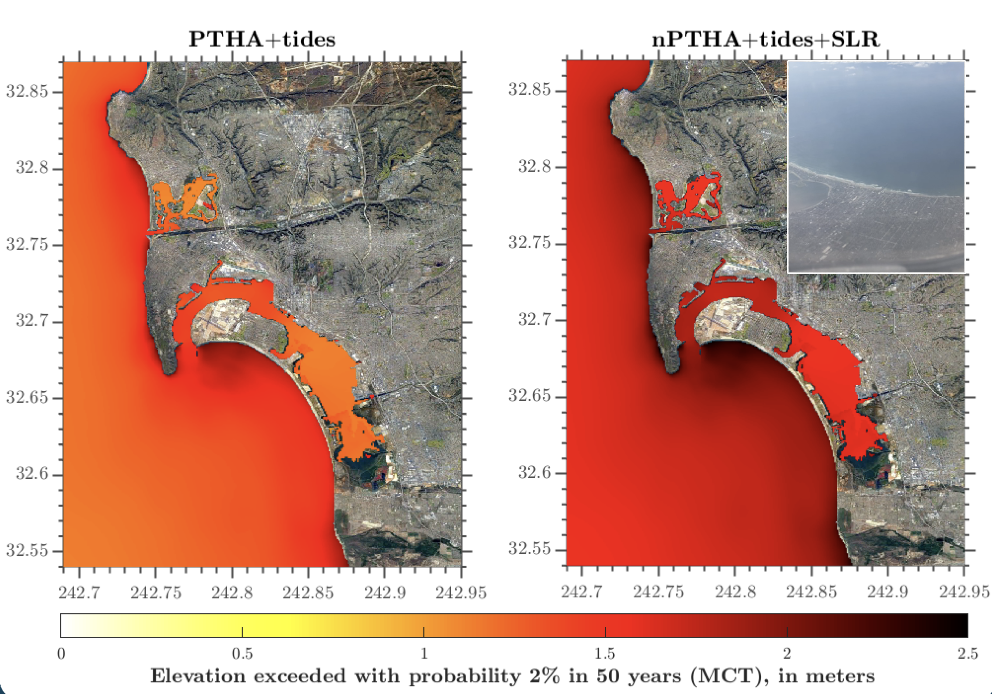
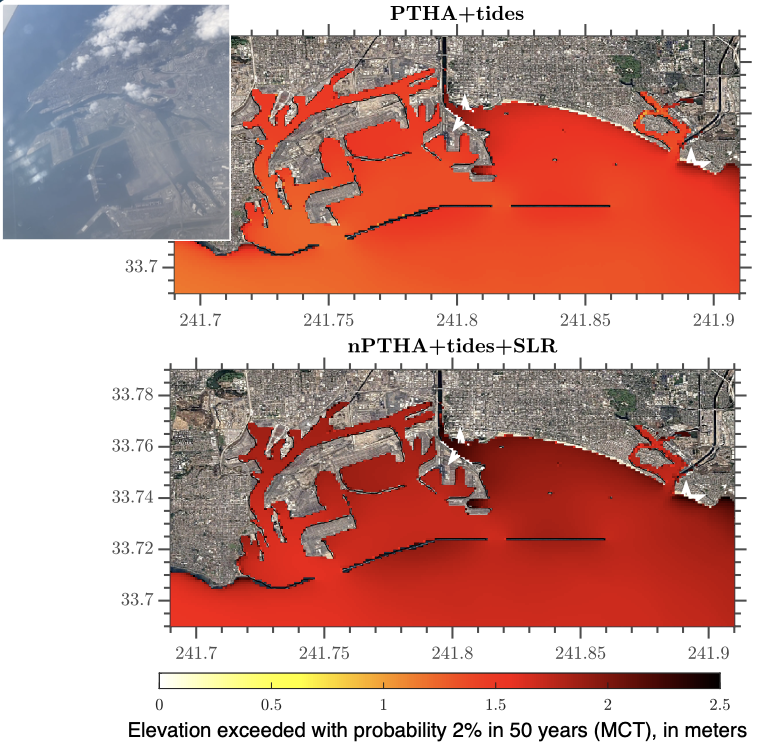
Applied nPTHA to Southern California to evaluate how sea-level rise modifies tsunami hazard from Alaskan and Cascadian sources and changes engineering-relevant design parameters.

Sepúlveda & Mosqueda (2025), Earth's Future.

Article
Comparison of PTHA with tides and non-stationary PTHA with tides and sea-level rise for San Diego
Southern California application: PTHA + tides compared with nPTHA + tides + sea-level rise in the San Diego region.
Comparison of PTHA with tides and non-stationary PTHA with tides and sea-level rise for the Long Beach region
Southern California application: corresponding comparison for the Long Beach region.

Related uncertainty research

Uncertain bathymetry

Bathymetric errors are characterized statistically and modeled as random fields, then propagated through nested tsunami models to quantify their effect on coastal predictions.

Polynomial Chaos Expansion

Spectral representations in random space are investigated as an efficient uncertainty-propagation strategy when stochastic dimensionality and numerical stability permit.

GARFIELD

Geophysical Applications of Random FIELDs develops spatially varying random-field models for applications including earthquake slip and bathymetry.