Physics, observations and models of tsunami generation, propagation and coastal impacts.
Science · 2026
SWOT detects dispersive tsunami tied to a near-trench source
Following the 29 July 2025 Mw 8.8 Kamchatka earthquake, the SWOT satellite captured a distinct train of short-wavelength tsunami waves. Sensitivity analyses linked this dispersive wavefield to tsunami generation within approximately 10 km of the trench, providing a source constraint that is difficult to obtain from land-based seismology, geodesy or sparse deep-water pressure sensors alone.
Sepulveda, I., Nilsson, B., Yu, Y., Carvajal, M., Brandin, M., Gabriel, A.-A., & Sandwell, D. (2026). Science, 391(6792), 1368–1372.
Open paperSWOT observations and tsunami-wave structure associated with the 2025 Kamchatka event.
Featured research · Volcanic tsunamis
Atmospheric waves can generate global tsunamis
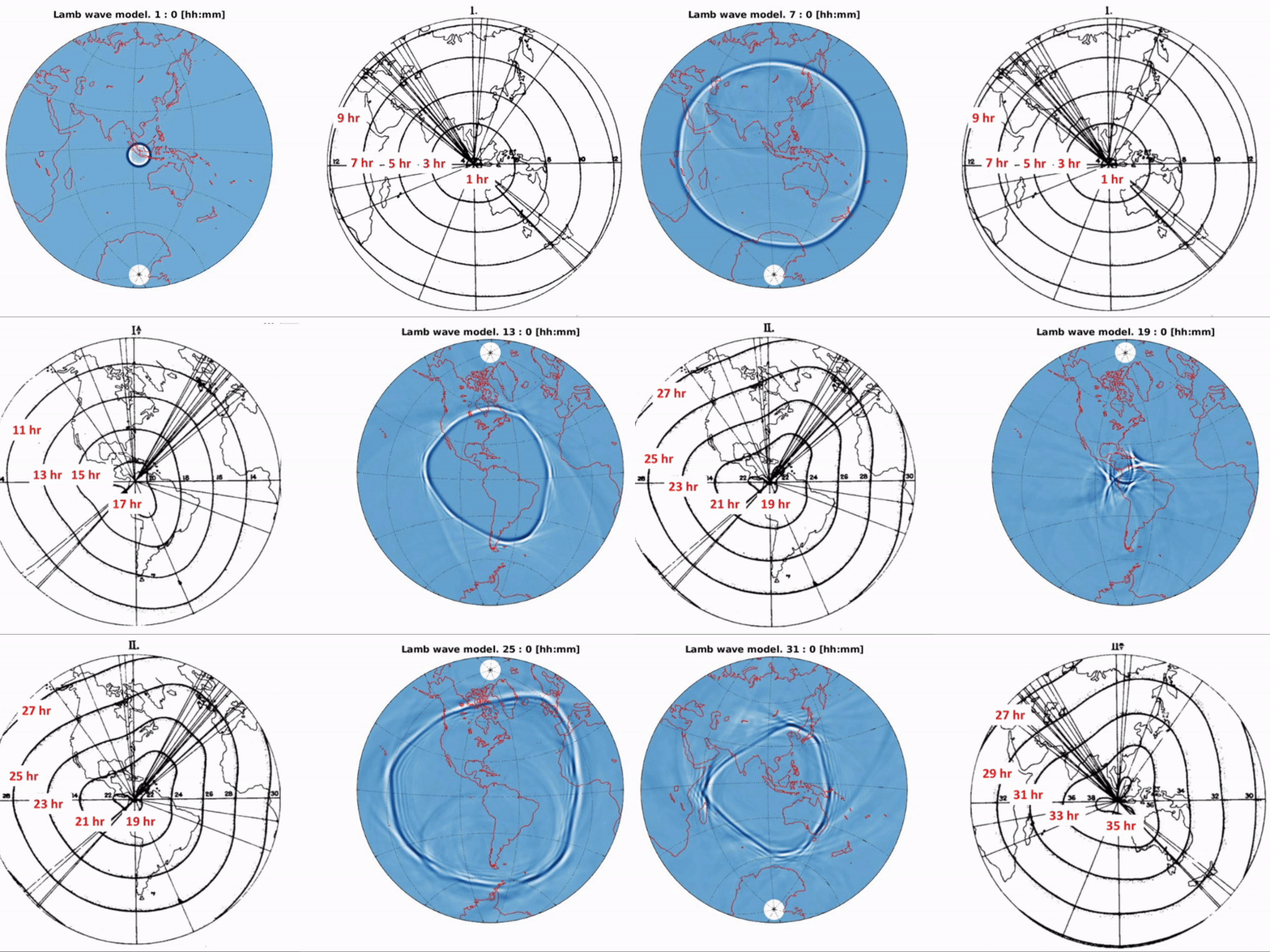
The 2022 Hunga Tonga-Hunga Ha'apai eruption generated a planetary-scale Lamb wave and tsunamis throughout the world’s oceans. Our work developed an augmented atmospheric-wave model incorporating global winds and topography, and numerical tsunami tools for pressure-wave forcing. The framework was also tested against the historical 1883 Krakatoa event.
The 2023 Geophysical Research Letters study showed that global winds are a dominant control on planetary Lamb-wave propagation, improving the reproduction of satellite and barometer observations and strengthening the physics available for volcanic-tsunami hazard assessment.
Atmospheric-wave propagation.Numerical model comparison.
Model validation.1883 Krakatoa reconstruction.
Tsunami models and source processes
Meteotsunamis
Atmospheric pressure and wind disturbances can generate long waves with important coastal amplitudes. This work develops numerical approaches for meteorologically generated tsunamis and has included simulations of the 2013 U.S. East Coast event.
Runup from earthquake fault parameters
Closed-form expressions were developed to estimate tsunami runup and breaking behavior directly from earthquake fault-plane characteristics, providing a simplified connection between source parameters and coastal response.
Tsunami generation by shallow earthquakes
Research examines how near-source dispersion, crustal heterogeneity, seafloor topography and horizontal seafloor deformation affect tsunami initial conditions and source inversions. The 2014 Iquique tsunami has been used to compare shallow-water and dispersive generation approaches.
Tsunami–tide interaction
Nonlinear shallow-water simulations of Chacao Channel, Chile, showed that tidal stage and tidal currents can substantially modify tsunami elevations and flows.
Palu: landslides and citizen observations
Social-media and CCTV videos were used to reconstruct tsunami time histories and constrain source inversions for the 2018 Palu event, supporting a major contribution from landslide-generated waves.
Coastal impacts and past events
Tsunami hazard is connected to infrastructure performance, fragility and coastal vulnerability. Field and modeling studies include the 2010 and 2015 Chile tsunamis, the 2014 Iquique event and other coastal hazards.
Applied & earlier tsunami studies
Engineering applications and field studies
Landslide-tsunami risk for a projected basin
Landslide scenarios in Chile's San Pedro River were modeled to evaluate tsunami-like waves and potential impacts on a proposed hydroelectric project.
Tsunami risk and protection at an LNG terminal
Hypothetical earthquake-tsunami scenarios were simulated in Quintero Bay together with conceptual coastal-protection alternatives for critical seawater infrastructure and assessment concepts for vessel drift.
Chile tsunami field and event studies
Field and modeling research has included the 2010 and 2015 Chile tsunamis, the 2014 Iquique event, tsunami–tide interaction in Chacao Channel, and other post-event investigations. The Robinson Crusoe survey is presented under Sensing because of its emphasis on field measurements.